
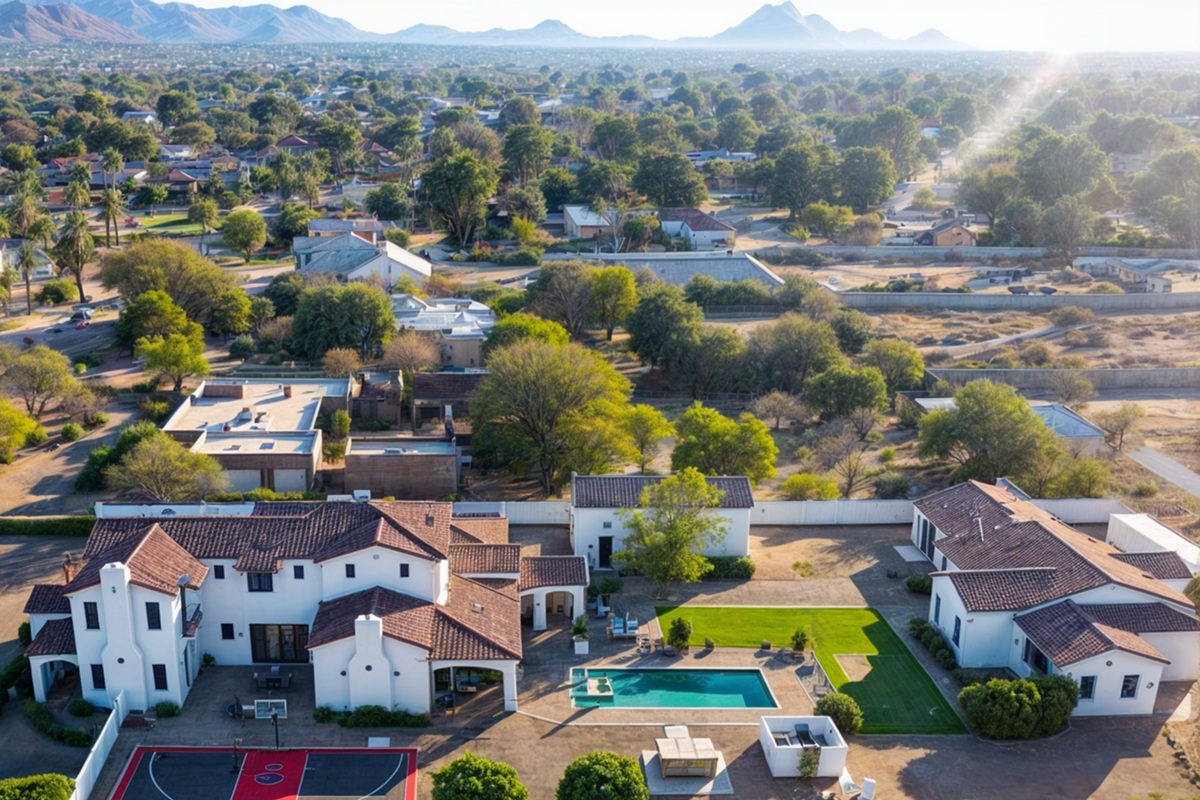
Some Cactus Corridor homes read much closer to Paradise Valley than modern Scottsdale — and that’s not accidental.
Long before North Scottsdale became synonymous with master plans, gates, and lifestyle branding, this stretch along Cactus Road between Frank Lloyd Wright Boulevard and 52nd Street developed the way Paradise Valley did: one property at a time, land first, house second. That DNA still governs how value is created, how buyers behave, and why this area continues to trade differently than almost everything around it.
Cactus Corridor Homes were mostly built before branding took over.
Cactus Corridor was never meant to be a “neighborhood.” It emerged organically from county zoning, horse property parcels, and early custom home development beginning in the 1960s and continuing into the early 1990s. There was no master developer, no unifying architectural theme, and no HOA-driven identity.
Owners built here because they wanted space, permanence, and autonomy — not because they were buying into a concept.
As Scottsdale expanded north and Paradise Valley solidified its borders to the west, this strip became a geographic in-between: close to everything, governed by almost nothing.
That history explains why today you’ll still find:
• True ranch-era homes sitting on irreplaceable acreage
• Long-held family properties with minimal turnover
• Quiet tear-downs where the land is the prize
• High-end contemporary rebuilds that would feel perfectly at home in Paradise Valley
Uniformity never arrived here — and that’s precisely the point.
Land Is the Asset — Everything Else Is Secondary
Like Paradise Valley, Cactus Corridor is fundamentally a land market.
Lots commonly run ¾ acre to over an acre, and value is driven by usability rather than square footage. Orientation, setbacks, access points, and zoning flexibility routinely matter more than finishes. Two homes with nearly identical interiors can trade dramatically differently based solely on the dirt beneath them.
This creates a market dynamic many buyers don’t expect:
• Renovated homes don’t always outperform originals
• Overbuilt houses can be value-limited by lot constraints
• Tear-down pricing is often rational, not speculative
Buyers here tend to think five to ten years ahead. They’re not purchasing a static product — they’re securing control over future options.
HOA Reality: Similar to Paradise Valley, Rare in Scottsdale
One of the most consistent reasons buyers land here is freedom from heavy governance.
Much of Cactus Corridor has no HOA at all. Where associations exist, they’re typically light-touch — road maintenance, minimal standards, little interference. Architectural review committees, design mandates, and lifestyle rules are largely absent.
That autonomy attracts buyers who want to:
• Add guest houses or detached casitas
• Maintain RV access, workshops, or collector garages
• Remodel or rebuild without committee oversight
In a Scottsdale market increasingly defined by regulation, Cactus Corridor feels refreshingly old-world.
Golf Proximity Without Golf Control
Cactus Corridor shares another key trait with Paradise Valley: golf is nearby, not intrusive.
Residents enjoy close access to several established clubs without living on fairways or paying for bundled lifestyle costs.
Notable nearby options include:
•McCormick Ranch
•Kierland-area golf and practice facilities to the north
Many Corridor residents are golfers — they simply prefer driving to golf rather than living inside it, avoiding course exposure risk and HOA entanglement.
Schools That Quietly Underwrite Value
Despite its organic structure, Cactus Corridor benefits from stable, respected school zoning within the Scottsdale and Paradise Valley Unified School Districts
Typical zoning includes:
Cochise /Anasazi Elementary School
Cocopah/Mountainside Middle School
Chaparral/Horizon High School
These schools don’t create hype cycles — they create liquidity. Even buyers without children understand the long-term implications, which is why values here tend to remain resilient regardless of market flavor.
Who Buys Here — And Why
Cactus Corridor buyers are rarely new to the market. They’ve usually eliminated DC Ranch, Arcadia, and gated North Scottsdale before arriving here.
They’re looking for:
• Central access without subdivision density
• Large lots without architectural mandates
• Long-term land security over short-term aesthetics
• A property that can evolve as their needs change
Seller Reality: Positioning Matters More Than Polish
Selling in Cactus Corridor is closer to selling in Paradise Valley than selling in Scottsdale.
Buyers price land first. They discount stylistic overreach. They ask zoning questions early. Homes that sell efficiently are those that clearly articulate what the property is — and what it can become.
The Bottom Line
Cactus Corridor is one of Scottsdale’s last areas where ownership still means control. It exists because Scottsdale once allowed property to be shaped by owners rather than developers — and because a certain class of buyer still values that model deeply. Like Paradise Valley, it rewards patience, clarity, and long-term thinking.
FAQ Cactus Corridor Homes
Is Cactus Corridor a gated community?
No. Cactus Corridor is not a master-planned or gated community. It’s a collection of larger-lot residential pockets, which is part of what gives it a more open, non-uniform feel.
Do homes in Cactus Corridor usually have HOA fees?
Many properties do not have an HOA. This is one of the main reasons buyers look here, especially those who want fewer restrictions on how they use their property.
What lot sizes are typical in Cactus Corridor?
Lot sizes are significantly larger than typical Scottsdale subdivisions. Many homes sit on parcels close to an acre or more, with some properties offering even more land.
Are homes in Cactus Corridor mostly older or newer?
Both. You’ll find a mix of older homes, updated remodels, and newer custom builds. The area has seen steady redevelopment as buyers replace or fully renovate older properties.
Can you find horse property in Cactus Corridor?
Yes. Some parts of Cactus Corridor allow for horse property or have an equestrian-friendly layout, which is part of the area’s appeal for buyers looking for space.
How does Cactus Corridor compare to gated Scottsdale communities?
Cactus Corridor offers more land and fewer restrictions, but without the structure, amenities, or security of gated communities. Buyers are usually choosing between space and flexibility vs managed community living.
What do buyers usually prioritize when choosing a home in Cactus Corridor?
The main factors are lot size, privacy, location within the area, whether the home is remodeled or a teardown candidate, and how much flexibility the property allows compared to HOA-controlled neighborhoods.
Is Cactus Corridor a good place to buy a luxury home in Scottsdale?
For buyers who want land, privacy, and fewer restrictions, Cactus Corridor is one of the stronger options in Scottsdale. It’s not built like a typical luxury subdivision, so the value comes more from lot size and flexibility than from amenities.
Why are homes in Cactus Corridor so expensive?
Pricing is driven more by land than by the house itself. Larger parcels, central location, and redevelopment potential all push values higher compared to nearby neighborhoods with smaller lots.
Are there new construction homes in Cactus Corridor?
Yes, but most new construction comes from tear-down or rebuild projects rather than large-scale developments. Buyers will often see newer custom homes mixed in with older properties.
Is Cactus Corridor better than Paradise Valley for larger lots?
It depends on budget and preference. Paradise Valley typically has higher pricing and more estate-style properties, while Cactus Corridor can offer similar lot sizes at a lower entry point but with less prestige.
Are short-term rentals allowed in Cactus Corridor?
In many cases, yes, especially in areas without an HOA. However, buyers should verify current city regulations and any property-specific restrictions before purchasing.
Is Cactus Corridor a good fit for buyers who want no HOA restrictions?
Yes. That’s one of the biggest reasons people target the area. Buyers who want flexibility for remodeling, additions, or property use often prioritize Cactus Corridor over HOA-controlled communities.
What are the downsides of buying in Cactus Corridor?
The trade-offs usually include less uniform neighborhood appearance, fewer shared amenities, and the need to evaluate each property individually since there’s no consistent community standard.