
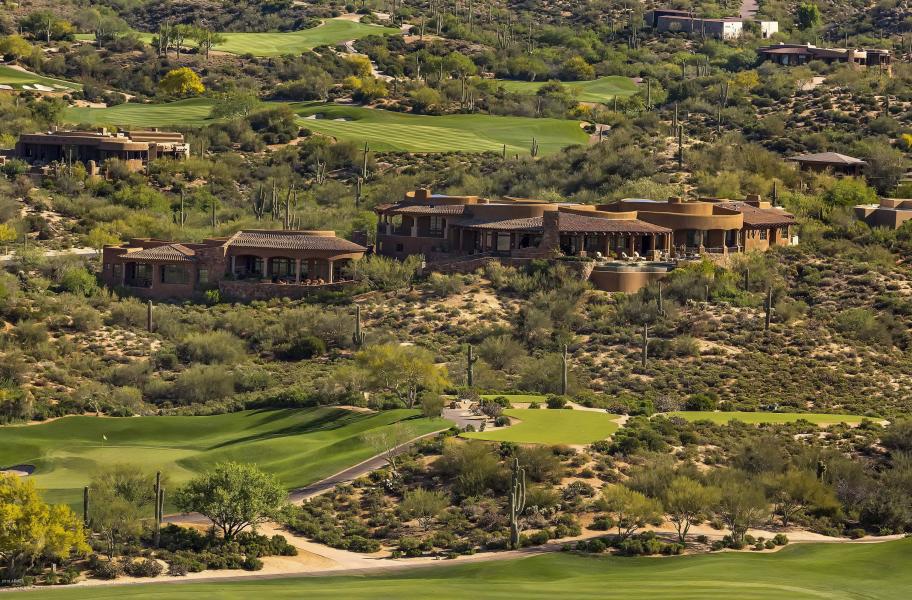
Desert Mountain Homes For Sale in North Scottsdale: Desert Mountain is one of the largest and most complex private residential communities in North Scottsdale, built around a membership-based club model that emphasizes golf, security, elevation, and internal self-sufficiency. Unlike most master-planned communities that focus on housing variety and retail integration, Desert Mountain was designed as a private lifestyle ecosystem—a place where residents can live, recreate, socialize, and retreat almost entirely within the gates. For many buyers, Desert Mountain represents the purest expression of North Scottsdale private-club living, with scale, prestige, and internal diversity that few communities can match.
How Desert Mountain Was Developed — and Why It’s Structurally Different
Desert Mountain began development in the mid-to-late 1980s, during the early expansion of North Scottsdale into the high Sonoran Desert. The vision was ambitious: create a community large enough to sustain multiple private golf courses, clubhouses, and residential villages, while preserving vast tracts of natural desert through careful planning and controlled density.
Rather than building outward indiscriminately, Desert Mountain was organized as a series of residential villages, each with its own character, elevation profile, and housing type, all tied together through a single club and association structure. This approach allowed the community to grow without losing internal cohesion — a key reason Desert Mountain still feels intentional rather than fragmented.
Location, Elevation, and Desert Setting
Desert Mountain sits at the far northeastern edge of Scottsdale, where elevation rises and the desert becomes more rugged and expansive. This setting creates a distinct living experience:
- cooler evening temperatures than central Scottsdale
- darker skies and reduced light pollution
- long-range desert and mountain views
- strong separation from commercial corridors
While the location feels remote, Desert Mountain is designed to be internally complete. Residents typically plan trips into town rather than living in daily traffic patterns, which appeals to buyers seeking privacy and retreat.
The Village Structure: Desert Mountain Is Not “One Neighborhood”
Desert Mountain is composed of multiple named villages, each with different housing types, densities, and buyer appeal. Some villages focus on custom homes on larger lots, while others offer patio homes, townhomes, or lock-and-leave options.
Village choice affects:
- elevation and views
- proximity to specific golf courses or clubhouses
- HOA structure and dues
- buyer profile and resale dynamics
Two homes with similar square footage can live very differently depending on which village they’re in — making village-level analysis essential for accurate pricing and buyer guidance.
HOA and Membership Reality
Desert Mountain is HOA-governed and club-driven. Visit Desertmountain.com for more info.
Do you have to own a home in Desert Mountain to obtain a golf membership?
Generally yes. Desert Mountain’s golf memberships are closely tied to property ownership within the community. However, purchasing a home does not automatically include membership, and buyers should verify whether a property includes a transferable membership or if separate club approval and waitlist procedures apply.
Does every Desert Mountain home include golf membership?
No. Some homes include transferable memberships while others do not. Membership availability can significantly impact both value and timing, making it important for buyers to verify membership status before purchasing.
Is Desert Mountain HOA membership the same as club membership?
No. All property owners belong to the Desert Mountain HOA, but club membership is separate and includes additional fees, privileges, and approval requirements.
Homes, Architecture, and Development Patterns
Homes in Desert Mountain span several decades of construction, from the late 1980s through more recent custom builds. Architectural styles range from classic southwestern to desert contemporary and modern custom designs.
Value drivers include:
- elevation and view corridors
- privacy and spacing between homes
- architectural quality and site integration
- renovation level relative to village expectations
Because Desert Mountain is so large, quality varies widely. Buyers benefit from understanding which villages emphasize exclusivity and which prioritize density or convenience.
Golf: The Defining Feature
Golf is the backbone of Desert Mountain’s identity. Visit Our Desert Mountain Golf Page for all Desert Mountain Golf Info.
The community is known for having seven private golf courses, a distinction that sets it apart nationally. These courses are designed to reflect different aspects of the desert terrain and offer varied playing experiences for members.
Golf here is not incidental — it’s a central organizing element of daily life, social interaction, and community culture. Membership often includes access to multiple clubhouses, dining venues, and golf-related social programming.
For golf-centric buyers, Desert Mountain is often unmatched in Scottsdale.
Schools and Family Considerations
School assignment is address-specific and must always be verified, but families in Desert Mountain commonly evaluate:
- Copper Ridge School
- Mountainside Middle School
- Desert Mountain High School
That said, Desert Mountain tends to skew toward:
- retirees and semi-retired professionals
- second-home owners
- buyers whose lifestyle centers around the club
Families with younger children typically weigh commute times and daily logistics more carefully due to the community’s location.
Lifestyle & Day-to-Day Living
Life in Desert Mountain is largely internalized.
Residents often spend their days:
- golfing or using club fitness facilities
- dining at one of the club’s restaurants
- walking desert trails within the community
- attending member-only events and social gatherings
Trips into North Scottsdale are purposeful rather than routine. Desert Mountain appeals to buyers who want to disconnect from constant activity and live in a quieter, self-contained environment.
Buyer Profile: Who Desert Mountain Is For (and Isn’t)
Desert Mountain attracts buyers who:
- want a private club lifestyle
- value golf as a central activity
- prefer gated security and structure
- seek privacy and desert immersion
- plan long-term or seasonal living
It is generally not ideal for buyers who:
- prefer non-HOA environments
- need frequent access to central Scottsdale
- want nightlife or retail nearby
Pricing, Value, and Resale Reality
Pricing in Desert Mountain is driven by:
- village selection
- elevation and views
- proximity to specific golf courses or clubhouses
- architectural quality and condition
Resale strength is supported by:
- the community’s scale and prestige
- limited direct competition
- consistent demand from club-oriented buyers
Because Desert Mountain is complex, correct pricing depends on micro-location and membership context, not broad neighborhood averages.
If you’re considering Desert Mountain and want guidance grounded in how the community actually functions — not just its reputation — reach out to discuss fit, timing, and long-term planning. Contact
Estancia. Carefree. Desert Highlands. Troon
FAQ’s Desert Mountain Homes for sale
What is Desert Mountain in Scottsdale?
Desert Mountain is a luxury, guard-gated master-planned golf community in North Scottsdale known for high-end homes, private club amenities, scenic desert surroundings, and a strong resort-style lifestyle.
Is Desert Mountain a golf community?
Yes. Desert Mountain is one of Scottsdale’s best-known private golf communities, with six Jack Nicklaus-designed courses in Arizona plus the par-54 No. 7 course.
How expensive are homes in Desert Mountain?
Desert Mountain is one of Scottsdale’s higher-end luxury markets. Live market pages show a median listing price around $3 million, with many homes priced higher depending on views, lot size, architecture, and membership access.
What types of homes are available in Desert Mountain?
Buyers can find custom estates, golf villas, lock-and-leave residences, and luxury homesites across multiple villages and neighborhoods within Desert Mountain. They are NOT all huge and Expensive
Is Desert Mountain guard-gated?
Yes. Desert Mountain is a gated private community, and gated access is a major draw for buyers seeking privacy, security, and a more exclusive North Scottsdale setting.
Do you have to join the club to live in Desert Mountain?
Not every home purchase works the same way, and membership access can depend on the property and current club rules. Desert Mountain’s own real estate pages highlight that some homes include club membership access, so buyers should verify current membership terms during the purchase process.
Why do buyers choose Desert Mountain?
Buyers are drawn to Desert Mountain for its combination of luxury homes, private golf lifestyle, extensive club amenities, scenic desert and mountain views, hiking and biking access, and a prestigious North Scottsdale location