
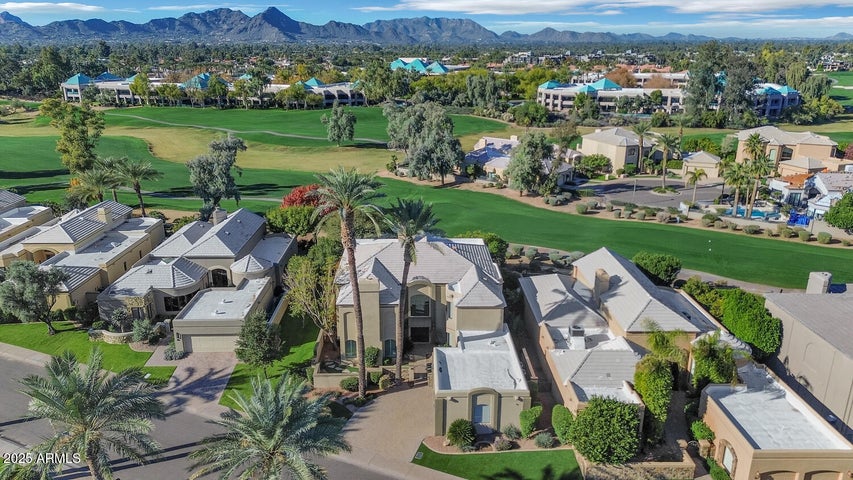
(Gainey Ranch Homes For Sale)
Gainey Ranch is a gated master-planned community in Central Scottsdale that blends residential villages, golf-course corridors, and resort-adjacent living in a way that few Scottsdale neighborhoods can replicate. It’s not “just a golf community” and it’s not simply “an upscale subdivision.” Gainey Ranch is better understood as a collection of distinct gated villages built around a maintained, curated environment—one designed from the start to feel polished, stable, and consistently “Scottsdale” even decades after construction.
For relocation buyers, Gainey Ranch is often the first place that feels like it solves the Scottsdale checklist: central location, gated structure, mature landscaping, dining and shopping close by, and a lifestyle that doesn’t require a long drive to feel alive.
Historical context: what the land was, and why the community developed the way it did
Before it became residential, the property was a large ranch associated with Daniel C. Gainey’s operations—part of Scottsdale’s pre-master-planned era when this corridor had more open land and agricultural use than most people realize today. Multiple sources describing the community’s origin emphasize that the ranch acreage was later acquired for planned residential development and that construction began in the mid-1980s after the 1980 acquisition by Markland/Markland Properties.
That timing matters. Gainey Ranch was built during the period when Scottsdale was refining its identity as a resort-lifestyle city. The planning priorities were not “maximum lots” or “entry-level housing.” They were:
- a gated, maintained feel as a core feature,
- residential villages with distinct identities (not one uniform subdivision),
- golf as a visual and lifestyle backbone,
- and a location that keeps you in the middle of Scottsdale’s daily conveniences.
This is why Gainey Ranch still holds its market position: it was designed to be a long-term lifestyle product, not a short-lived development cycle.
Location: central Scottsdale convenience that actually matters day-to-day
Gainey Ranch sits along the Scottsdale Road corridor in Central Scottsdale, which is one reason it consistently attracts full-time residents and seasonal owners. It’s close to Old Town, Paradise Valley, and North Scottsdale without forcing you into the “far north” tradeoff where every errand becomes a drive.
The big practical advantage: you can live behind gates and still be near the places Scottsdale residents actually use weekly—restaurants, shopping, fitness, resorts, and medical services—without a 20–30 minute commitment each way.
Gainey Ranch is many villages, with different lifestyles and different rules
“Gainey Ranch” is the master label, but buyers don’t experience it as one homogeneous place. The Gainey Ranch Community Association itself organizes the community into multiple named neighborhoods/villages across single-family and condominium-style living.
You’ll commonly hear residents and experienced agents refer to specific villages rather than “Gainey Ranch” broadly, because village choice determines:
- how private it feels,
- whether it’s more lock-and-leave vs family-oriented,
- the HOA structure and costs,
- architectural rules,
- and how resale comps should be selected.
- weather its more Golf or Tennis oriented
Examples of village names (as organized by the community association) include: The Estates, Golf Villas, Golf Villas III, The Greens, The Legend, North Meadow, North Meadow II, Vaquero Drive, and multiple condominium communities such as The Courts and others.
Broker reality: Two homes can be “in Gainey Ranch,” a mile apart, and live like completely different neighborhoods.
Gainey Ranch Villages & HOA Fees, + security is explicit and part of the value proposition
Yes—Gainey Ranch is HOA-governed, and it’s intentionally structured that way. The community is managed through its association and is widely described as having a security-focused, gated environment.
Here’s what buyers should understand is the HOA is a key component and will cost approximately $400-$900/month. Visit the Gainey Ranch HOA page for more details
- There is a master association (community-level standards and shared components).
- There are sub-associations (village-level rules, architecture, maintenance, and dues).
- Rules and dues vary dramatically depending on whether the property is in a single-family village or an attached/condo-style community.
Fees vary by neighborhood based on property type (condo, townhouse, or single-family) and the level of maintenance provided
- The Estates: Total monthly assessment of $661
- The Pavilions: Monthly fees typically range from $225 to $719.
- Golf Villas at Gainey Ranch: Monthly fees cover common area and street maintenance plus trash collection; specific satellite fees vary by unit.
- Gainey Village (Villas/Casitas): Neighborhood fees are approximately $375/month, which may be in addition to or inclusive of certain master fees depending on the specific sub-association.
- Other Villages: Gainey Ranch contains several other distinct neighborhoods, including:
- North Meadow and North Meadow II.
- Golf Villas III
- The Legend at Gainey Ranch.
- The Enclave and Vaquerro
What the Fees Cover:
Satellite Associations: Typically fund neighborhood-specific needs such as building painting, roof repair (for condos/townhomes), and private street maintenance
Master Association (GRCA): Funds 24/7 guard-gated security, master landscaping, the Gainey Ranch Estate Club (pool, fitness center, tennis, pickleball), and community administration.
Why buyers pay for it: the HOA structure is a big reason the community maintains a consistent Look, Feel, Value and Security
Golf:
Golf is a defining part of Gainey Ranch’s identity, but it’s important to be precise.
The community is anchored by Gainey Ranch Golf Club, which is structured as three distinct nine-hole courses—commonly referenced as Arroyo, Dunes, and Lakes—that can be combined into different 18-hole routings. Click here to See our Gainey Ranch Golf Page
Why that matters to buyers:
- Homes with golf frontage often command premiums for views and open corridors.
- But some buyers avoid golf lots due to exposure, activity, and long-term privacy concerns.
- The “best” golf-adjacent lot depends on whether the buyer prioritizes view, privacy, or quiet.
So: golf is a value driver—but only when it matches the buyer’s lifestyle, not because a listing says “on the course.”
Homes, architecture, and renovation reality
Most homes in Gainey Ranch were built in the mid-1980s through the 1990s development arc referenced by community history sources.
That means buyers are typically choosing between:
- Original or lightly updated homes (often with more traditional layouts), and
- Renovated homes that better match modern expectations.
Architecture is generally consistent with Scottsdale’s upscale design language of that era—stucco exteriors, tile roofs, courtyards, and a stronger “resort” aesthetic than older ranch-style neighborhoods like McCormick Ranch.
Resale nuance: Renovations outperform when they respect the architecture and floorplan logic instead of forcing a generic flip style that doesn’t fit the home.
Lifestyle:
Gainey Ranch’s day-to-day appeal isn’t theoretical—it’s tied to the immediate lifestyle nodes around it. A major anchor is The Shops at Gainey Village, a long-standing Scottsdale retail/dining hub adjacent to the community. Notable spots there include Village Tavern and Pomo Pizzeria Napoletana, both listed directly in the center’s directory.
Another defining lifestyle element is resort adjacency. The resort at Gainey Ranch is now branded as Grand Hyatt Scottsdale Resort, and it has undergone major renovation/updates in recent years—an important detail because it keeps the area’s hospitality “gravity” current instead of aging out.
This is one of the reasons Gainey Ranch remains attractive to seasonal buyers: you get a residential community feel with resort-grade amenities, dining, and activity nearby, without living in a transient hotel district.
Schools:
Most Gainey Ranch homes are served by the Scottsdale Unified School District.
Common Public School Options
- Cochise Elementary School
- Cocopah Middle School
- Chaparral High School
School boundaries should always be independently verified by buyers prior to purchase.
Nearby Private & Charter Schools
Arizona Jewish Academy
Rancho Solano Preparatory School
Notre Dame Preparatory High School
BASIS Scottsdale
Phoenix Country Day School
Buyer psychology: who this fits
Gainey Ranch tends to attract buyers who want:
- a gated, maintained environment,
- a “finished” neighborhood feel (not a new-build tract),
- Central Scottsdale access,
- and a lifestyle that mixes residential calm with nearby dining and activity.
It’s usually not the best match for buyers who want:
- no HOA oversight,
- maximum exterior freedom,
- or purely modern/new construction as the default.
Gainey Ranch Homes for sale and value dynamics
Gainey Ranch tends to hold value because the fundamentals remain durable:
- central location,
- gated/maintained community structure,
- recognized name,
- and a broad buyer pool (full-time + seasonal + downsizers).
Within the community, pricing is usually driven by:
- village selection (because HOA and lifestyle differ),
- renovation quality,
- micro-location (quiet interior placement vs more exposure),
- and golf adjacency (only when it matches buyer preferences).
Do not price “Gainey Ranch” as one market. Village-level comps are the only defensible way to be accurate.
Buying or selling in Gainey Ranch
Buyers: start with the village that fits your lifestyle (lock-and-leave vs single-family privacy), then search within that lane. Otherwise you’ll compare homes that aren’t actually comparable.
Sellers: the fastest way to leave money on the table is to position a home as “in Gainey Ranch” without telling the story of the village, the lifestyle, the HOA structure, and why your micro-location matters.
Considering Gainey Ranch?
If you’re exploring Gainey Ranch and want guidance that’s village-specific and grounded in how the community actually functions, reach out and we’ll map your criteria to the right pocket inside the gates. Contact
Related Scottsdale Neighborhoods
FAQ’s Gainey Ranch Homes For Sale
Is Gainey Ranch gated?
Yes. Gainey Ranch is widely marketed as a guard-gated Scottsdale community, which is one of its biggest draws for buyers who want central location plus privacy and controlled access.
What types of homes are available in Gainey Ranch?
Gainey Ranch offers a broad mix of property types, including condos, townhomes, villas, and detached luxury homes. That range is part of what makes it appeal to both full-time residents and lock-and-leave buyers
Do Gainey Ranch homes usually have HOA fees?
Yes. HOA fees are common in Gainey Ranch, especially for condos and many single-family sections. Buyers should expect at least a master-association structure, and in some neighborhoods there may also be a separate sub-association fee.
Is Gainey Ranch a good fit for buyers who want lower-maintenance living?
Yes. Compared with many larger-lot Scottsdale communities, Gainey Ranch has more lock-and-leave style options, including attached homes and smaller patio-style properties, which makes it attractive to seasonal owners and buyers who want less exterior upkeep.
Are detached luxury homes available in Gainey Ranch, or is it mostly attached housing
Both are available. While Gainey Ranch is well known for condos, villas, and townhomes, live listings also show larger detached homes priced into the multi-million-dollar range.
What makes Gainey Ranch different from other Scottsdale communities?
Gainey Ranch stands out for its central Scottsdale location, guard-gated setting, broad range of housing options, and easier access to shopping, dining, and everyday conveniences than many farther-north luxury communities